The Black Dog of Depression (Part 1)

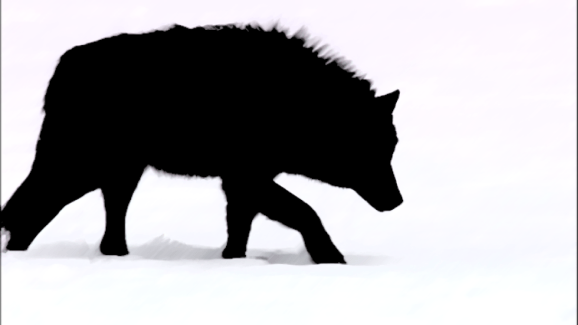
Black Wolf painted‘The Black Dog’ is a famous phrase or analogy for depression. Its fame stems from its usage by Winston Churchill as publicised by his doctor, Charles Wilson the 1st Baron Moran. Moran published Winston Churchill: The struggle for survival, 1940-1965 in 1966 to much controversy about his apparent breach of doctor-patient confidentiality. Within the 900-page volume he spoke candidly about Churchill’s struggles with depression, something he referred to as Churchill’s ‘black moods’ or the ‘Churchill meloncholia’. He gathered from Churchill’s friends that there was a belief that this depressive strain was hereditary, passed down through the Dukes of Marlborough, but happily for Winston tempered by the ‘bright, red American blood’ from his mother which ‘cast out the Churchill melancholy’.⁠1 Churchill’s friend Brendan Bracken (who purposefully fostered rumours that he was Winston’s illegitimate son) traced this depressive strain to Churchill’s childhood, when he ‘deliberately set about to change his nature, to be tough and full of rude spirits’. ‘You see’, he continued, ‘Winston has always been a “despairer”… Winston has always been moody; he used to call his fits of depression the “Black Dog”.’⁠2

It seems likely that Churchill’s use of the phrase has a deeper antecedent. Churchill’s private secretary John Colville believed that he had learned the phrase from a childhood nurse: 

Of course we all have moments of depression, especially after breakfast. It was then that [Lord] Moran [Churchill’s doctor] would sometimes call to take his patient’s pulse and hope to make a note of what was happening in the wide world. Churchill, not especially pleased to see any visitor at such an hour, might excuse a certain early-morning surliness by saying, “I have got a black dog on my back today”. That was an expression much used by old-fashioned English nannies. Mine used to say to me if I was grumpy, “You have got out of bed the wrong side” or else “You have got a black dog on your back”. Doubtless, Nanny Everest was accsutomed to say the same to young Winston Churchill. But, I don’t think Lord Moran ever had a nanny and he wrote pages to explain that Churchill suffered from periodic bouts of acute depression which, with the Churchillian gift for apt expression, he called “black dog”. Lady Churchill told me she thought the doctor’s theory total rubbish…⁠3 

Indeed, the phrase ‘the black dog has walked all over him’ or ‘he has the black dog on his back’ is an old one, referring to someone experiencing a melancholic or sullen mood (OED). The idea of the black dog as an ill omen or bad luck has very long roots. Brewer’s Dictionary of Phrase and Fable notes that Horace called the sight of a black dog with its pups an ‘unlucky omen’. A marvellous article by Paul Foley which delves deep into the etymology of the ‘black dog’ phrase notes that this was likely based on a mistranslation, but nonetheless Horace’s evocation of the black dog as a dark companion who broods and follows is a poignant one: 

No company’s more hateful than your own

You dodge and give yourself the slip; you seek 

In bed or in your cups from care to sneak

In vain: the black dog follows you and hangs

Close on your flying skirts with hungry fangs.⁠4

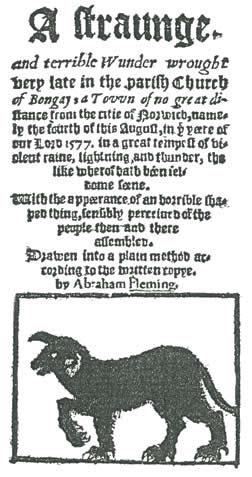
Black Shuck - historical
‘Black Shuck’

In a broadly Christian context, meanwhile, the Black Dog has long been associated with the devil, and folklore in England and Ireland is known to refer to terrifying, large black dogs with red eyes that stalk unaccompanied travellers at night. This was of course the roots of Conan Doyle’s Hound of the Baskervilles in which Sherlock Holmes’s stubborn rationalism wins out over the dark superstititions of the Devonshire moors. Black dogs have long been considered gaurdians of the underworld – from the most famous Cerberus, to more local variants such as the Welsh Cŵn Annwn, the Manx Moddey Dhoo (also known as Mauthe Doog) or the Barghest of north-east England. Interetingly, Shuck, the ghostly dog who is said to haunt the East Anglian coastline, seems to derive its name from scucca, meaning devil, and/or skuh, meaning to terrify (OED). A Dictionary of English Folklore suggests that  ‘The many phantom dogs of local legend are almost invariably large black shaggy ones with glowing eyes; those which appear only in this form are simply called “the Black Dog”, whereas those that change shape often have some regional name such as bargest, padfoot, or Shuck.’ The changing shape of such local variants brings the legends back to a devilish connection, the devil being commonly thought able to change his form. In the famous words of Shakespeare, ‘The devil hath power / To assume a pleasing shape’ (Hamlet, Act 2 scene 2). 

For most, though, the particular association between the Black Dog and the idea of depression and melancholy comes from Samuel Johnson and his correspondence with a friend, Mrs Thrale. Johnson has imprinted his version of the Black Dog onto the historical record because of his fame, eloquence and inveterate letter-writing. Given his love of language (as the compiler of the first Dictionary of the English Language) it is perhaps fitting that his use of the term seems to have amalgamated these many forms, from the suggested ill-omens of Horace, to the devilish connotations of local folklore. ‘The black dog I hope always to resist, and in time to drive, though I am deprived of almost all those that used to help me’, wrote Johnson to Mrs Thrale on 28th June 1783. 

When I rise my breakfast is solitary, the black dog waits to share it, from breakfast to dinner he continues barking, except that Dr Brocklesby for a little keeps him at a distance… Night comes at last, and some hours of restlessness and confusion bring me again to a day of solitude. What shall exclude the black dog from a habitation like this? 

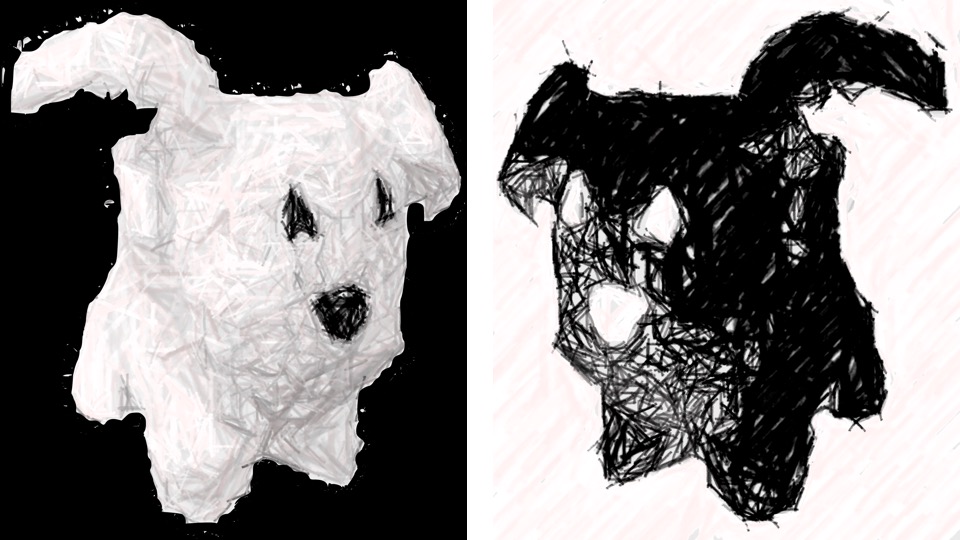
Loneliness, fear and confusion jump off the page from this passage across the intervening centuries. The Black Dog lurks and lumbers, begs and worries (in the sense of a dog worrying sheep I suppose). It haunts and glares and follows and disturbs. It is the phantom dog of folklore lurking in the shadows, the ill-omened dog of Horace flying at your skirts, and the heavy dog of meloncholy weighing down your back. Johnson’s solitary musings are a painful reminder that the black dog thrives in isolation, but also enforces its existence, making social intercourse difficult, and asking for help nigh-on impossible. Luckily the White Dog doesn’t need to be asked. 

1 Lord Moran, Winston Churchill: The struggle for survival, 1940-1965 (London: Constable, 1966), p. 745.

2 Lord Moran, Winston Churchill: The struggle for survival, 1940-1965 (London: Constable, 1966), p. 745.

3 Colville J (1995) The personality of Sir Winston Churchill ( = Crosby Kemper Lecture, 24 March 1985). In: Kemper RC (ed), Winston Churchill: Resolution, defiance, magnaminity, good will (Columbia: University of Missouri), pp. 108-125. See also Gilbert M (1994) In search of Churchill. A historian’s journey (London: Harper Collins), pp. 209f.

4 J. Conington, The satires, epistles, and Art of Poetry of Horace (London: George Bell & Sons, 1863), p. 90. [Cited in Paul Foley, ‘“Black dog” as a metaphor for depression: a brief history’, p. 3.

Failure to Love

Laundry basket

It’s hard now to remember that first week. Everything went downhill so fast and so suddenly. I never really had a chance to get my bearings. 

Anxiety is difficult to describe, but it reminds me of when you first learn to drive and you have to join a motorway. I didn’t learn to drive until I was in my early-20s. Being a Londoner I never had much use for it, but when I went to university ‘oop north’ it seemed like everyone had four wheels. I wasted time and money on the odd lesson here and there before finally knuckling down to an intensive course. Once you’ve passed your test you can finally on the motorway, and my first motorway driving was a baptism of fire: 100 miles towards my sister’s wedding with a car crammed with dresses, shoes and favours. It was terrifying. 

motorway_signEverything about the experience of joining the motorway is counterintuitive. You are approaching a dangerous hazard (the motorway itself), filled with cars going 60-80 mph. You have a short tun-up to the carriageway during which, as you approach others hurtling past, you have to speed up. As lumbering lorries bear down on you and thunder onwards you have to be looking in about five different directions, have to judge the judge the size and speed of your car and others, have to continue accelerating beyond the point of comfort, and in one deft manoeuvre have to slot into ongoing traffic, usually between two lorries so that you have minimal vision and can only hear the growling of their huge engines and the roar of over-sized tyres. 
For about two years the only way I could do it was by loudly singing the Superman theme tune. Foot on the accelerator, cars whoosing past me, tiny car-length target space ahead – a space moving at 70 mph and subject to the unpredictable driving of tired and angry motorists – I would break into song at full-lung, full-speed, full-scream. And of course, once you’re on there is no let up. Now you have to continue speeding up, change lanes, avoid lorries overtaking one another deal with angry white men driving up your bum, avoid sudden lane-changers, watch out for road signs and adjusted speed limits, roadworks, obstructions, sudden slowing, traffic jams, long journeys of fraying nerves and tired eyes that don’t blink enough. 

This is how it felt that first week. Hurtling towards a hazard, unable to stop, the only way forward – acceleration, looking in every direction at once, mentally scrolling though your packing, wondering if you’ve forgotten something, trying to remember the route. Total, 80 mph immersion in a fast-moving stream that never stops. This is Anxiety. And before you know it, you’re whizzing past every exit junction, trying desperately to get off, but unable to change lanes. Paralysed by sheer panic and going 100 mph just to show how confident you are. And inside, one long scream. 

* * *

He's watching you

Ted the White Dog followed me everywhere. Of course he did, he was only a puppy. Frightened and away from his litter for the first time, he skipped and slid around my feet as we paced the four walls of my flat. We couldn’t go out – he’d not had his final jabs yet. We had no garden – only a tiny balcony lined with puppy pads laid in an attempt to toilet-train him in a flat. Too sleep-deprived to work, or read, or function, we would plat half-heartedly, both sizing each other up over a cuddly toy. If I went to the toilet with the door closed he yelped and whined and cried. If I put him in his playpen he yelped and whined and cried. At night in his crate he yelped and whined and cried. And so did I. 

I had read so many books and absorbed so much advice about puppies that I had unwittingly built a barrier between us. Show the puppy who’s boss. Don’t let it sleep in your bedroom. Do not let it win any games. Feed it only after you have eaten. Do not let it on the furniture. Get it used to the crate. Leave it for increasing periods so that it gets used to being alone. Meanwhile in my own head I had laden the experience with so many expectations. As a perennial singleton with a love of children I had unconsciously convinced myself that this was a test for single-parenthood. If I could do this, I could raised a child alone. I could be alone and happy. I wouldn’t feel lonely or isolated for the rest of my life. I would be loved. I would be whole. But the Anxiety cut me off from love, even though it was what I craved. I was flailing. I was failing. I would be alone forever. I would always be sad and lonely and unloved. I would die alone and not even be eaten by cats because apparently pet-ownership was too much for me. What a loser. What a failure. What a waste of space. Can’t even handle one tiny, white puppy. 

I desperately wish I could have that time back. All I needed to do was to scoop that puppy up into my arms and love him with all of my might. That soft fur, those brown eyes. I should have just put my face into his puppy fuzz and kissed him and hugged him and loved him. I should have let him curl into my beck and drifted off to sleep with him on the sofa. I should have put his bed in my room and lain where he could see me, and smell me, and hear me. I should have woven my fingers around the bars so he could lick them, and know I was near. If I had that time again I would never stop snuggling him, or smelling him, or kissing him. But I was too busy driving at 100 mph towards a smash I didn’t know was coming. I was hurtling towards doom with no way off. 

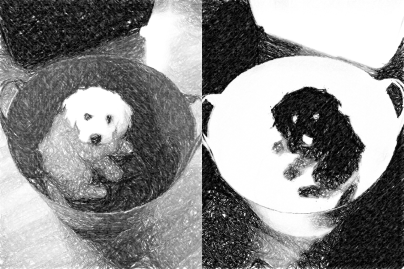
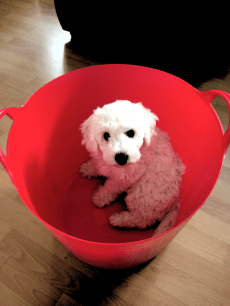
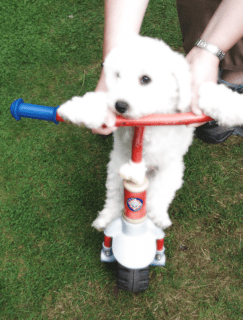
laundry basket 3As it was I tried desperately to love him. I played fetch and tug-of-war and peek-a-boo. I filled a  plastic bottle with treats and rolled it up and down the hallway. I started to teach him to sit (at 10 weeks! What an eegit), and then got frustrated when he didn’t. I wanted everything perfect and done all at once. Now. Yesterday. I was in a hurry to get to my new perfect life. Racing towards it blindly and dragging the poor up along with me. I put him in the laundry tub and took and picture in an attempt to find him cute. At my parents’ house I propped his front paws onto the handlebars of a scooter in an attempt to be whimsical.scooter I posted jolly, happy pictures on Facebook. I sat in the dark and cried while he watched me.
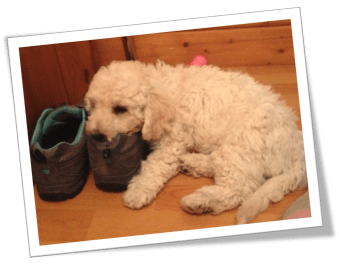
 

Every night he escaped from his crate and pooed all over the flat. The sharp tang of faeces and urine would wake me from half-slumber. He wasn’t fooled by the fake ‘grass’ on the balcony and refused to wee there. He hid behind my desk, watching e with reproachful eyes. Three days in I confessed to my mum that I might have made a mistake. Five days in I had a total panic attack one evening and couldn’t breathe. Seven days in and his bag was packed and I was a wreck. 

That’s when my parents saved us. 

* * *

Writing this is hard. It feels like shame. It tastes like failure. I can’t even express how much I adore Ted the White Dog now. I cup his face in my hands and kiss his nose. I put my face in his fur and take deep breathes of his musky scent. I sleep with him curled against my legs or back. When I can’t sleep, I drag him into a cuddle and match  my breathing to his own, feeling his deep snores resonate in my chest. I have a t-shirt that says: ‘If my dog isn’t invited, I’m not going’. And I mean it. 

But Anxiety and Depression numb you to good feelings, and worry over negative feelings insistently. Hot thoughts circle around your brain like a dizzy teacup ride. Its long, spiny fingers creepy into your chest and squeeze until you can’t breathe, can’t move, can’t think. Everything acquires a greasy film of grey. Your limbs move through thick, viscous oil. Your emotions shut down as a defence mechanism, hunkering into the tiny safe space at your core. They want to escape the Bad, but in the process they block out the Good. You don’t feel. You don’t taste. You don’t think or move or love. You just be. Be until it passes. Terrified that it never will.  

Puppy Day

Ted scrapbook style
The little white puppy was hiding in my shoe. I couldn’t bear to look at him. How could I have failed so spectacularly so quickly? Packing up his blankets, towels and toys was like leafing through broken dreams. Each soft and snuggly item was an artefact of hope, excitement and joy. They now cut cruelly to the quick – disappointment, failure and despair. The white puppy’s liquid eyes watched me in silent rebuke and painful surrender. Whispered promises I had crooned into his ear on that first day lay shattered between us.

“We will be best friends forever. You are a dream come true. I’ll protect you and cherish you always.”

Laying down a half-folded towel, I sank to the floor and wept.

*          *          *

I cannot tell you how much I had always wanted a dog. My favourite storybook as a child was Dogger – the Shirley Hughes classic about a boy’s love for his snuggly and beaten-up toy dog. My favourite book as a child was a huge A3-sized encyclopaedia of dog breeds. I barely had the strength to hold it up, but spent hours immersed in its glossy pages. My favourite toy was a scrappy and formerly white Grundy hound. Named Mutsy, he was a greying soft dog with brown button eyes and a still-white, still-fluffy patch tucked beneath the label on his ear, a label I had always refused to take off. He smelled of My Little Pony bed-linen, fierce childhood hugs, and Johnson’s baby shampoo. I still have the book and the toy, carefully stowed in the drawer beneath my bed. Packed away, but always close by. Just in case. For emergencies.

Indeed, I took Mutsy the toy dog with me to University. Disorientated by life in halls of residence, by strangers rapidly becoming friends, and by independence laden with expectation, Mutsy secured me and comforted me. At night I would crawl into my narrow bed and feel for him beneath the pillow. I hid him there during the day. My new flatmates and I lived in each other’s rooms, and no one needed to know about my security blanket and little fragment of home away from home. Popping an audiotape cassette into my stereo, I would snuggle into his worn fur.

A feature of halls of residence is the continuous nature of night-time fire alarms. Drunken students burning toast mostly, confused by the domestic arts and the efficiency of university smoke detectors. I kept a backpack next to my bed in readiness for our communal trudge out into the carpark. Mutsy would be slipped into it while I blearily found my shoes and shrugged myself into an outsized jumper. Shivering in the cold with my fellow pyjama-clad students (and a hilarious handful of one-night-standers still in their glad-rags from the night before), I was safe in the knowledge that my most precious possession was curled in the bottom of my bag. Safe and close and patiently waiting for the frustrated firemen to finish their lecture about misusing smoke alarms and endangering lives by distracting them from real emergencies.

If only I could care for this little white puppy with as much love and tenderness as I cared for that worn-out toy dog all of those years ago.

*          *          *

The day had finally arrived. Thirty-one years in the making. It was Puppy Day. Five years of postgraduate study and three years of precarious short-term employment had forestalled my dream of dog-ownership for long enough. I had been in my permanent academic post for two years now, giving it the requisite time to settle before taking any major life decisions. Being sensible. Bring responsible. Being the version of Me I thought I was supposed to be. In a couple of weeks I would be moving out of my flat into a house with a garden. The move itself was entirely designed to facilitate my getting a dog of my own. I would be moving further away from friends and family, but somewhere where I could afford a garden and still be close enough to visit frequently.

The move itself had been interminably delayed. One house had fallen through and the whole process had been forced to start again. Everything was slow. Solicitors and estate agents proved their worth by generating delays and crises that they could solve. Papers inched their way across the country. Why use email when paper is so much slower? After all, a slower process means more billable hours. I was supposed to have moved weeks ago, but the avalanche of paper was still at the creeping stage, not yet having reached the critical mass of ‘contract exchange’ whereupon everything suddenly tumbles down the mountain, sweeping vendors, estate agents and solicitors aside as it goes.

But Puppy Day could not be delayed. Puppy Day had been arranged for a long time. A 10-week-old bundle of curiosity and a barely contained bladder was waiting was for me. A brand-new travel crate was strapped into the passenger seat of my car. Two ceramic puppy bowls sat poised and pristine on a paw-print mat in my living room. A basket filled with worn-out towels and shiny new toys awaited its new inhabitant. Puppy Day had arrived and I was beside myself with excitement.

Bless his heart the little white puppy almost made it all the way home without throwing up. Forty minutes into the forty-five minute journey the sickly smell of half-digested puppy food wafted into my nostrils. I clucked soothingly,

“Never mind little fella. We’re nearly there. You have done so well.”

The little white puppy looked up at me with trusting eyes before gently and contentedly starting to lap up the little pile of puke. Parking up quickly I scooped him out of the crate and away from his impromptu meal. That could be cleared up later. I climbed the stairs with him snuggled against my chest. I could feel his heartbeat racing against my own.

“Here we go my little happy chappy. Home sweet home. Or at least”, I added sardonically, “home for a few more weeks… if we are ever able to move.”

We. That “we” felt good. I was no longer an I. We were a We. I was no longer alone.

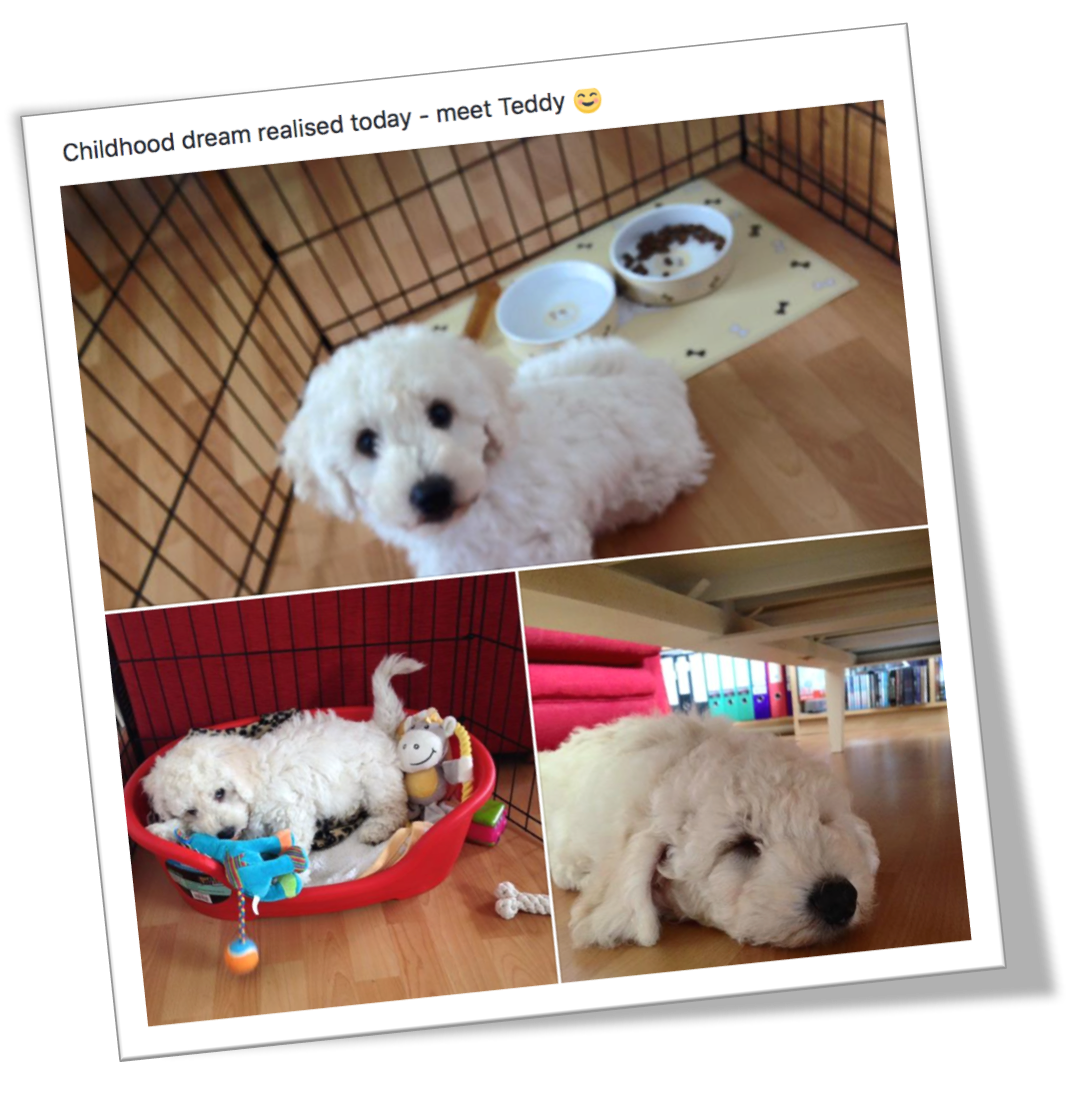
Being a (reluctant and frankly chronologically borderline) Millennial, I almost immediately whipped out my phone. Tucking the exhausted pupster into his new basket I snapped a quick picture and uploaded it to Facebook.

“Childhood dream realised today”, I tapped. “Meet Teddy.”

FB Post

Little did I know then that in one short week I would be packing up his hopeful belongings having torn myself apart with Anxiety, and tipped myself into the worst Depression of my life. Its speed was matched only by its ferocity. The White Dog was helpless as the Black Dog came gnashing into our lives.